Choreography, costume, lighting: Martha Graham.
Dancer: Martha Graham and her Group.
Music: Louis Horst.
Premiere: Maxine Craig Theatre, New York, February 2nd, 1931.
Photographs: click here , here , here , here , here .
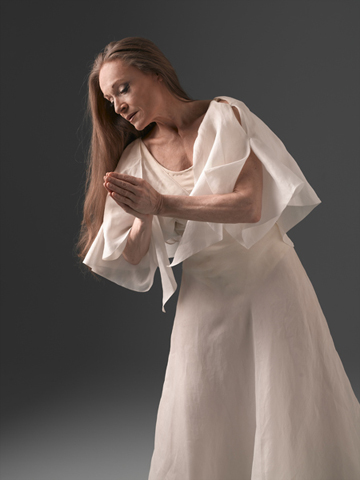
Primitive Mysteries is a group work inspired by the Virgin Mary. Divided into three parts, 'Hymn to the Viring', 'Crucifixus' and 'Hosannah', it portrays crucial episodes from the Bible, such as the cucifixion and deposition of Christ, as experienced by the Virgin. The movement quality of the piece is very spare and minimal, with the Virgin often moving from a pose to another as in a tableau vivant. She is the core of the piece, even when she stands completely still, as in a part of section two. Her costume is made of white organdy and consists of a wide skirt that poetically floats as she moves, while the one of the Group is blue and its skirt is not as wide. The Group surrounds the Virgin and, in more than one case, moves in smaller groups of two, three or four. One of the most significant aspects of the choreography is the processional walk done at the beginning and end of each section. It is done in unison by all the dancers and in complete silence, so as to create the sacred atmosphere of the piece. The title, as well as the idea for this dance, came from Graham's study of Native American cultures in the North American Southwest.
Here the link to my interview to Susan Sentler Reconstructed who has the piece in More Than One occasion, for the historical project at Laban .
-
choreography, costumes, lighting: Martha Graham.
Dancer: Martha Graham and his Group (group).
Music: Louis Horst.
First performance: Maxine Craig Theatre, New York, February 2, 1931.
Photos: click here , here, here, here , here.
Primitive Mysteries is a group dance inspired by the Virgin Mary. Divided into three parts, 'Hymn to the Viring', 'Crucifixus' and 'Hosannah', depicts the crucial aspects of the Bible as the Crucifixion and Deposition of Christ, who lived from the perspective of the Virgin. The quality of the movement of the piece is simple and minimal, with the Virgin who moves from one pose to another as in a tableau vivant. She is the heart of the piece, even when it is completely stopped for part of the second section. His costume is made of white organza and is developing into a wide skirt that floats poetically in his movements, while the Group is blue and her skirt is not as wide. The surrounding the Virgin Group and more than once you move into smaller groups of two, three or four people.
One of the most significant the choreography is done the walk in procession at the beginning and end of each section. Is performed in unison by all the dancers and in complete silence, so as to create the sacred atmosphere of the piece. The title and the idea of \u200b\u200bthe dance comes from the study that Graham did cutlure of Native American Southwestern North America. Here
link to my interview (in English) Susan Sentler who reconstructed the piece more than once for the historical project at Laban .



0 comments:
Post a Comment